


It all began on the Isle of Man
24.11.2025
- This year marks the 40th anniversary of the very first Island Games, held on the Isle of Man in 1985.
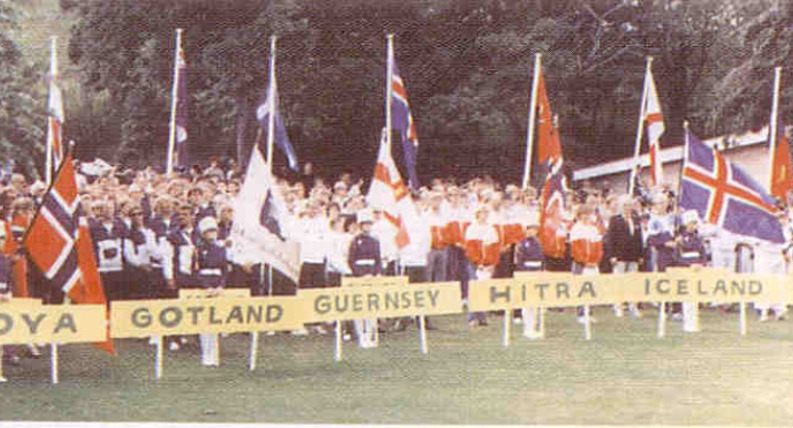
For Geoffrey Corlett, it was an unforgettable moment when 700 athletes from island communities around the world paraded onto the sports field in his hometown of Douglas on 19 July, flags waving in the sunshine while the theme from Chariots of Fire echoed from the speakers.
The idea of hosting a sporting event for island communities had emerged on the Isle of Man two years earlier, but Corlett had never imagined that the response would be so overwhelming.
When the starting gun sounded for what was intended as a one-off event, no one could have foreseen that it would become a recurring highlight for athletes from islands far and wide.
A special sporting year
The main reason for launching the 1985 Games was, in fact, economic.
For generations, the Isle of Man had been a popular holiday destination for working families from England and Northern Ireland, and tourism played a vital role in the island’s economy. But during the 1970s, package holidays to mainland Europe and the Mediterranean grew rapidly in popularity, drawing visitors away from the island and leaving the Manx tourism sector struggling.

In an effort to revitalise tourism, a range of special events and commemorations were introduced. One of them was the Millennium Year in 1979, marking 1,000 years of the Manx parliament, Tynwald. The celebrations attracted significant interest, and as a continuation of this success, the idea of declaring 1985 a Year of Sport was proposed — a year dedicated to celebrating sport in all its forms. Around one hundred sporting events were planned.
The island’s Tourist Board and Sports Council received political backing, and Tynwald approved a budget of £350,000 to support the initiative.
The year 1985 was chosen deliberately, falling between the Los Angeles Olympics in 1984 and the Commonwealth Games in Edinburgh in 1986.
At the age of 57, Geoffrey Corlett was appointed chief coordinator. He had grown up on the Isle of Man but spent most of his career in England as an adviser, teacher and lecturer in sports at the University of Cheltenham. Having returned to the island after retirement, he was now asked to design the programme for the Year of Sport — and he was bursting with ideas. One of them was a sporting event for island communities.
Office space overlooking Douglas harbour was provided, and Corlett set about sending invitations to islands within the British Commonwealth, as well as other island communities. One invitation was sent to the Faroe Islands.
"We then, with much interest, waited for the replies. Many islands quickly responded and accepted the invitation with great enthusiasm", Corlett wrote back in 1995.
The Faroe Islands joined immediately
The Faroese Confederation og Sports and Olympic Committee (ÍSF) was quick to register the Faroe Islands for what many described as a “mini-Olympics”.
Geoffrey Corlett had originally expected six to eight islands to compete in five sports, but the strong interest led to more sports and more islands being added. In the end, fifteen islands competed in seven sports.
The participating islands were Åland, Anglesey, Faroe Islands, Frøya, Gotland, Guernsey, Hitra, Iceland, Jersey, Malta, Orkney, Shetland, St Helena, Isle of Man and Isle of Wight.
In the Faroe Islands John Kjær was appointed to oversee the Faroese delegation — a demanding task.
Fifty-five Faroese athletes competed in volleyball, swimming, shooting, cycling and athletics — all of which required significant funding.
On 17 July 1985, a fully booked Boeing 737 carrying 128 passengers — athletes and supporters — departed from Vágar Airport for the Isle of Man.
Seven sports were contested, although the Faroes did not participate in badminton or indoor five-a-side football for youth players.
A Decision to carry the Games Forward
Although Corlett had never intended the Island Games to become a recurring event, talk quickly arose during the days in Douglas about continuing the competition. The event had been a clear success. As a popular tourist destination, the Isle of Man had the infrastructure and accommodation needed to host a multi-sport event.

At a meeting in Douglas on 23 July, it was unanimously agreed to make the Island Games a biennial event. Sofus Johannesen and John Kjær represented the Faroe Islands. Corlett was elected permanent secretary. At the same meeting, it was decided that Guernsey would host the 1987 Games, and the Faroe Islands the 1989 Games — coinciding with the 50th anniversary of ÍSF (the Faroese Confederation of Sports and Olympic Committee).
Heðin Mortensen, who served as president of ÍSF for 28 years, later stated that the Island Games transformed Faroese sport.
“When we sent just a handful of people to the first Games in 1985, it was a huge challenge. Since then, the Games have been the greatest driver of development in Faroese sport. Smaller sports in particular gained new life, and many have grown even stronger since,” he said in an interview with the Faroese newspaper Sosialurin in 2013.
The weather during the Games on the Isle of Man was favourable, though the return flight was delayed by a day due to thick fog.
A legacy far greater than expected
After the event, Corlett had to acknowledge that the Games had become something much larger than anyone had imagined. Over the years, they developed into more than a sporting competition.
“We are all justly proud of our Association and hope that future generations will remember the fundamental aims and principles on which these Games were founded. These were to foster and strengthen the spirit of true friendship between our island communities through sport, cultural links and social interaction, and that in striving to achieve excellence in performance, the values of fair play and good sportsmanship should remain a central theme in our Games,” Corlett wrote in 1995, summarising the first five editions of the Games.
Geoffrey Corlett passed away in 2012 at the age of 86. He attended every Games up to 2011 and was later made an honorary member of the International Island Games Association (IIGA).

Sources:
- Geoffrey Corlett: History of the Island Games 1985–1995
- Heri Simonsen: The Founding Father of The Islands Games: Geoffrey Corlett (interview, 2009)
- Matthew L. McDowell: ‘Come alive in ’85’: the Isle of Man Year of Sport, the first Island Games, and the shifting sands of sport event tourism
- Ítróttasamband Føroya: Oyggjaleikir in Ítróttasamband Føroya 50 ár
- Sosialurin, August 3, 1985
- Sosialurin, July 10, 2013
Other News

05.10.2026
Search begins for the 2027 Island Games Song

30.06.2026
Member Islands Arrive for Pre-Visit

27.03.2026
Betri Island Games Unveil Mascot

03.12.2025
Sculpture Installed in the Gundadalur Swimming Pool

30.10.2025
Games Equipment Arrives in the Faroe Islands

15.10.2025
Hotel Brandan donates pillows to the Games